How to Survey Bumblebees on Heathland: A Simple Citizen Science Method
Late summer on a lowland heath is one of the great small spectacles of the countryside: bell heather turning purple, gorse pods cracking in the heat, and a low, steady hum rising from the flowers. Much of that hum is bumblebees. They are also among the easiest insects to watch properly, because they are large, they land, and they stay put long enough to look at. Turning a good walk into useful conservation data takes only two things: a fixed route, and the patience to walk it the same way every time.
Why heathland bumblebees are worth counting
Heathland has been broken into fragments across north-west Europe, and the bees that specialise in it have gone with it. The heath bumblebee is largely confined to heaths and moorland. The bilberry bumblebee depends on upland heath and its food plants. Where these species still hold on, the records are often thin, clustering around car parks, viewpoints and the paths people happen to walk.
A transect fixes that. It gives a land manager a consistent picture of which species use which parts of a site, when they appear, and whether numbers are holding or slipping. Grazing levels, scrub control, bracken cutting and burning rotations all change bee habitat, and none of those decisions improve without feedback. Well-kept transect records are that feedback.
Before you go: the right conditions
Bumblebees need warmth to fly. A dry, bright day with light wind is what you want; a workable rule of thumb is at least 15°C in sunshine, warmer if the sky is overcast, and wind below a stiff breeze. Rain stops play, and a cold grey morning will give you nothing but a wasted hour. Aim for mid-morning to late afternoon, when flowers are open and workers are out.
Your kit does not need to be expensive:
- A printed recording form with fields for date, times, weather and species — or a notebook with the same fields ruled in.
- A pencil. Pens seize up in damp air.
- A hand lens and a phone with a decent close-up camera. Photograph tricky bees on the flower before they leave.
- A net only if you already know how to use one gently and have permission. Most beginners can identify the common species without catching anything.
- Water, sun cover and long trousers. Heathland is tick country.
Laying out your transect
One kilometre is a good working length — long enough to cross different patches of habitat, short enough to finish in under an hour. Choose a start point you can find again on a dark evening: a gate, a bench, a corner of a car park, a grid reference written on the form.
Walk a line that takes in the range of the site. If you can include both an area of gorse and an area of heather, do. Count only bees within about five metres ahead and to either side, and don't count anything behind you. If your route curves back on itself, walk a separate parallel line rather than retracing your steps, or you will double-count.
Sketch a simple map and mark any features — a wet flush, a bare bank, a stand of young birch. Those notes make the data far easier to interpret later, and they help if someone else takes over the route.
Walking the route
- Note the start time, temperature, wind strength and how much cloud is in the sky.
- Walk slowly and steadily, at a pace where you can still see individual flowers. Rushing is the single most common mistake.
- Scan ahead and to the sides. Look at the flowers, not at the sky.
- When a bumblebee lands, stop and watch it. Note the flower, the caste if you can tell — queen, worker or male — and the species.
- Pause your watch while you identify. A bee flying straight past without landing should be noted separately, if at all.
- At the end, note the finish time and anything that changed: cloud building, wind picking up, sun going in.
Do not chase bees off flowers to see them better. Let them work, and they usually give you a clear view of the tail and bands within a few seconds.
Telling the bees apart on heather and gorse
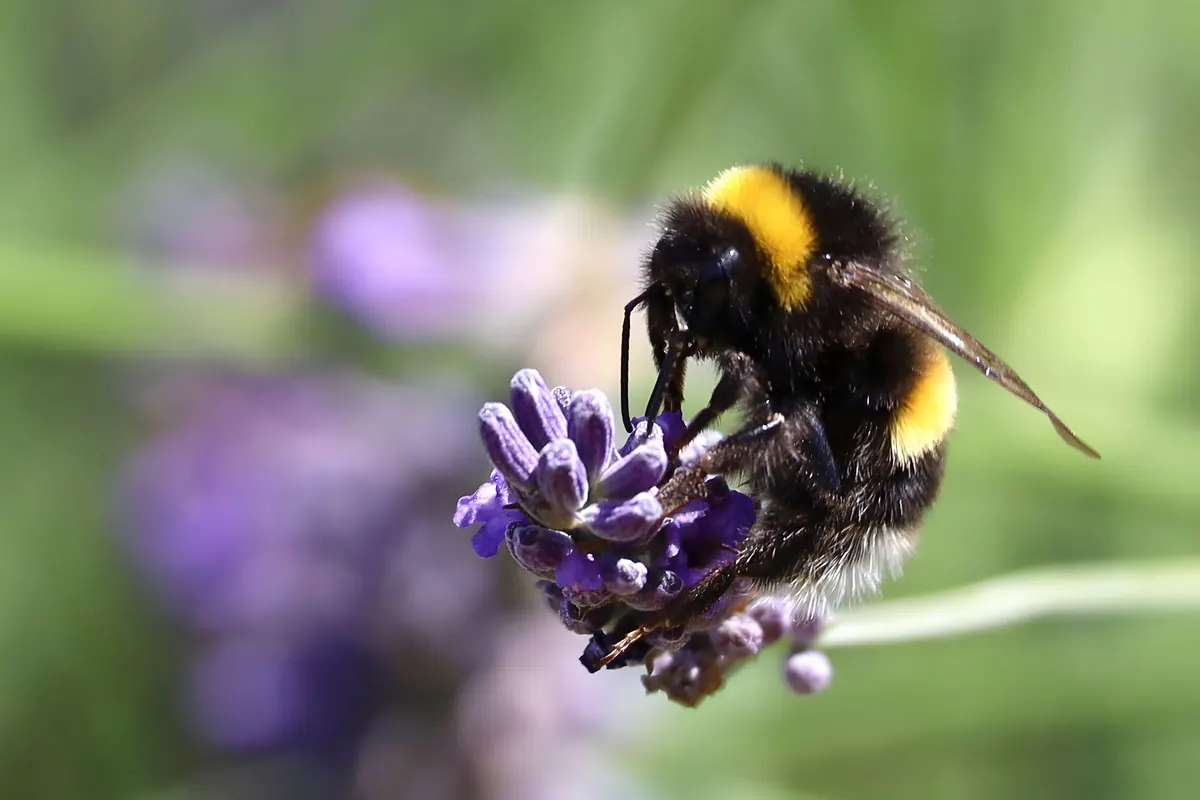
Start with the tail. White, red, buff or ginger, or no obvious tail colour at all. That single feature splits the common species into groups and saves a lot of squinting. Then count the pale bands and note where they sit on the thorax and abdomen. Finally, use size: queens in spring are large, workers in midsummer are smaller, and males appear later, scruffier and slower.
Gorse in spring
Gorse flowers early, sometimes before the year has properly warmed up, and it draws the first large queens out of hibernation. Red-tailed, white-tailed, buff-tailed and early bumblebees are all worth expecting here. Gorse is prickly, so stand back and watch from the path rather than pushing into the bushes.
Heather in summer
Bell heather and ling carry the season. The heath bumblebee is small, short-haired and easily overlooked — it is the one most worth slowing down for. Common carder bees are brownish and untidy. White-tailed and buff-tailed bumblebees remain common. By late summer, males are on the wing; they have longer antennae, no sting, and they patrol rather than feed neatly, which makes them harder to pin down.
When you cannot tell
Record it as unidentified, with the flower, the tail colour and a photograph if you got one. An honest "unidentified" is worth far more than a confident guess, because a wrong record can send a recorder looking in the wrong place for years.
Recording and sharing what you find
One form per visit. Date, start and finish times, weather, transect name, then each bee with its flower and caste. Keep a copy for yourself in a spreadsheet so you can compare years, and send the records to your local environmental records centre, county bee recorder or a national recording scheme. Note the first and last date you see each species — those dates shift with the climate, and they are some of the most valuable information a volunteer can produce.
Making it a habit
A single walk tells you very little. The same walk, every two weeks from early spring to early autumn, tells you a great deal. Ten to fifteen visits a season, repeated over several years, is how a hobby becomes a record.
Stay on the paths where you can, and keep off young heather and bare ground in spring, which is where ground-nesting birds such as nightjar and curlew will be sitting. On private land, ask first. On protected sites, check whether you need permission before you start. Check yourself for ticks when you get home, and take the usual care in strong sun.
Then go back next fortnight. That is the whole trick.
Photo: Nigel Cohen / Pexels